How to Make a Household Chore Chart Work for Your Home
A household chore chart can clarify who handles recurring work, expose overlooked tasks and give your home a simple way to revise responsibilities together.
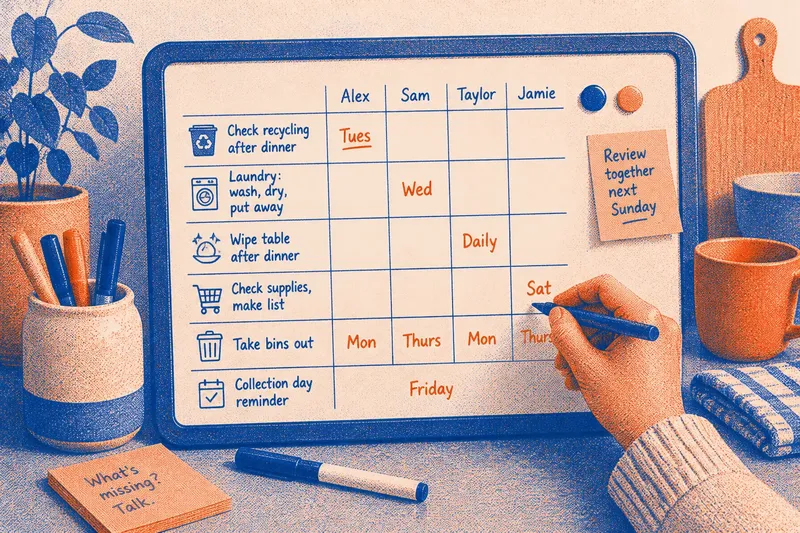
Who is meant to take the recycling out, and when? A household chore chart can answer that small, recurring question before a full bag is left by the door. Its value lies less in keeping score than in making responsibilities clear enough to share and revise.
A household chore chart should name actions, not vague areas
“Kitchen” can mean anything from wiping the table to cleaning the hob. A chart is easier to use when it describes an observable action, such as “wipe the table after dinner” or “put away clean dishes”. Clear wording reduces guesswork without prescribing every detail.
Include the parts of a task that are often left implicit. “Laundry” may involve noticing the basket is full, starting a wash, hanging or drying clothes, and putting them away. If a household wants to share the whole job, its chart should show more than the moment someone presses a button.
Choose a layout that answers one clear question
A chart organised by person makes ownership prominent; one organised by day foregrounds timing. A room-based layout can gather linked jobs together. Choose the arrangement that resolves the household’s main uncertainty rather than trying to fit every possible detail onto one page.
- Check whether people forget when a task is due; if they do, put days or occasions first, then use a person-based layout if timing is already clear.
- Check whether a task has no obvious owner; if it does, put names beside actions, then use a shared rotation if fixed ownership feels unsuitable.
- Check whether several jobs belong to one space; if they do, group them by room, then split the list by person if ownership remains unclear.
- Check whether instructions are being interpreted differently; if they are, replace broad labels with specific actions, then keep a broader heading only where everyone agrees what it means.
- Check whether the chart is difficult to change; if it is, use pencil, a whiteboard or removable notes, then choose a fixed printed sheet only if the arrangement rarely changes.
- Check whether marks prompt useful conversation or feel like monitoring; if they feel intrusive, remove completion ticks, then keep a simple reminder list if the household still needs cues.
These choices are practical rather than decorative. Like a labelled drawer, a well-named task makes it easier to find what belongs where; the label should help, not turn ordinary household work into an examination.
Make the division visible without treating every task as equal
A list can show who does what, but it cannot automatically make different jobs equivalent. Tasks vary in frequency, effort, timing and the attention needed to plan them. Listing “prepare dinner” without meal planning or checking ingredients may leave important work outside the chart.
Review the list together and ask what is missing: who notices supplies are running low, who remembers collection day, and who handles follow-through? The aim is a workable shared account, not a score that ranks each person’s contribution.
Use a review to repair unclear assignments
A chart needs changing when the household’s routines change or when a task repeatedly causes confusion. A short conversation can identify whether the problem is the timing, the wording, the assignment or the fact that the job was never listed. Keep the revision small enough that people can see what changed.
Say a household’s recycling bags are often still inside on collection morning. Imagine its members agree that the person who cooks on Tuesday checks the bags after dinner, and add “check recycling after dinner” to a whiteboard; the next collection morning, they can see whether the agreed check happened and decide whether the timing or assignment needs adjustment. The invented situation starts with a missed collection, takes a specific action and leaves an observable point for review.
Which household chore chart choices answer common questions?
What should a household chore chart include?
List recurring tasks that people need to coordinate, using wording that makes completion recognisable. Add planning or follow-through where those parts are otherwise easy to overlook.
Should chores be assigned by person or rotated?
Fixed assignments can suit tasks that fit a person’s routine, while rotation can make recurring jobs visibly shared. A household can combine the two, provided everyone affected understands the arrangement.
When should a chore chart be updated?
Revise it when routines or household circumstances change, or when the same assignment repeatedly causes confusion. If the chart no longer reflects daily life, change the page rather than expecting people to follow an outdated arrangement.
How can a chore chart avoid feeling like a scorecard?
Use it to clarify responsibilities and provide reminders, not to rank people by ticks or missed boxes. If marks feel uncomfortable, remove them and review responsibilities in conversation instead.
A useful household chore chart is easy to read, easy to amend and honest about what its labels leave out. Keep the main search phrase in view when choosing a format: the chart should help your household answer who does what, while leaving room to change the answer when life changes.