Open Trays or Lidded Boxes for Everyday Bits?
Open trays or lidded boxes can make everyday essentials easier to find or surfaces calmer to look at; choose the form that fits each item’s routine.
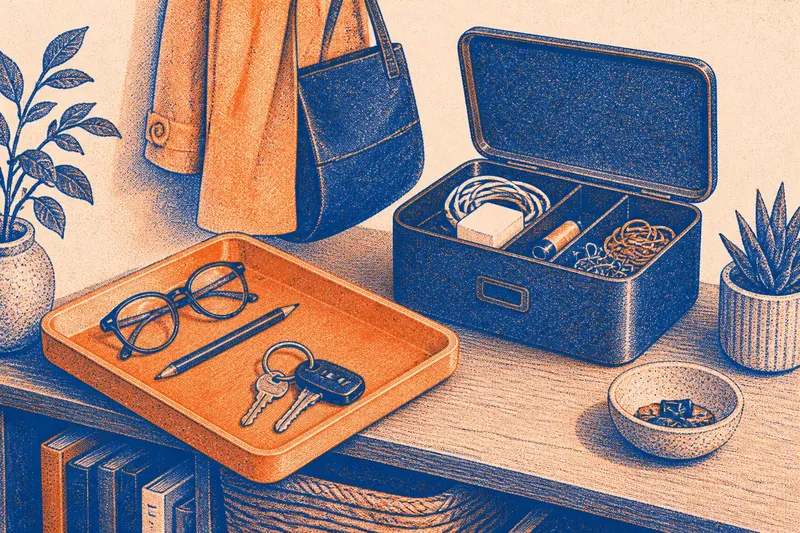
Should everyday bits sit in an open tray or disappear into a lidded box? Open trays or lidded boxes suit different routines: a tray keeps things visible and ready to hand, while a box hides them behind one extra action. That difference can decide whether keys, clips or charging leads return to the same place.
Match the container to the problem
A tray can catch objects that would otherwise land wherever a hand happens to be free. A box can conceal a loose assortment or protect its contents from dust and stray fingers. Neither form creates a habit by itself; its position and capacity matter as much as its appearance.
Notice what is going wrong now. Are you searching for an item, seeing too many small objects, keeping things you no longer need, or leaving a lid off because putting it back feels like another task? Name the specific irritation before choosing a container. A solution to visual clutter may slow access, while a solution to searching may put more objects on display.
A tray is like a desk: its contents stay in view. A lidded box is more like a drawer: the surface looks quieter, but the contents take an extra action to reach. The useful question is which kind of order the spot needs.
Keep an open tray from becoming a dumping ground
A tray may begin with a clear purpose and gradually collect unrelated objects: a receipt, a spare button, a coin, then something with no obvious home. Because every addition stays visible, the collection can look messy even when it is contained. The tray’s rim sets a physical boundary, but it does not set a limit on what belongs there.
Give the tray one job, such as holding things needed on the way out or small tools used at a particular desk. Remove objects that do not support that job, then place the tray where the relevant action already happens. If a daily item keeps travelling elsewhere, reconsider the tray’s location or purpose.
Say you leave reading glasses and a pencil beside a chair, while receipts and loose change have started gathering there too. Clear the tray, put the receipts where household papers are handled, and keep only the glasses and pencil beside the chair. The expected result is a visible landing place for those two objects, rather than a mixed collection to sort each time.
Make a lidded box easy enough to use
A box can reduce visual noise, but its lid adds a small action to every retrieval. If someone needs the contents often, that action may be skipped: the lid stays off, or objects are put beside the box. This does not necessarily mean the person lacks discipline; the container may ask for more handling than the routine comfortably allows.
Use the box with its lid on during ordinary use and notice where the contents end up. If the lid is regularly left aside, switch to a tray, a shallow open container or a box with an attached lid that is easy to move. If the contents are still returned, the box may be concealing them without disrupting the routine too much.
Separate frequent-use objects from occasional ones. A closed box may suit spare batteries or craft supplies used now and then, while a tray may suit a pen or hair tie reached for repeatedly. Group objects only when they are used together; otherwise, a box can turn retrieval into rummaging.
Keep box contents visible enough to find
Out of sight can become out of mind. A deep box filled with similar-looking items may conceal its contents, while small objects settle beneath larger ones. It can look calm from the outside but behave like an unlabelled drawer when opened.
Check whether the box is too deep or too full. A shallow box makes its contents easier to see; a small divider can keep different kinds of objects apart. If the contents vary, add a plain label to the lid or front that names the broad category, rather than listing every object.
If you still cannot remember what is inside, move the box nearer to where its contents are used or reconsider whether they belong in everyday storage. Frequently needed things are easier to retrieve when they are encountered as part of the routine, rather than stored in a distant cupboard.
Choose a container that fits the surface
A large tray or decorative box can claim more room than its contents need. A roomy tray may invite extra objects, while a bulky lid can make a narrow shelf awkward to use. This often happens when appearance takes priority over the contents and the place where they will sit.
Gather the objects that genuinely belong together and compare their combined footprint with the available surface. A tray should leave useful space around it; a box should open without knocking into nearby objects. If the container crowds the area, try a smaller one or divide the contents by where they are used. Do not add objects simply to fill an oversized container.
Material and finish also affect how a container works in a room. A woven tray may catch threads or crumbs more readily than smooth metal or glazed ceramic, while a clear box reveals rather than conceals its contents. Choose a surface that suits the objects and can be cared for as part of ordinary cleaning.
How do open trays or lidded boxes fit different routines?
Which is better for keys and daily essentials?
A tray often suits objects picked up and put down during the same routine, provided it sits near the entrance or departure point. A lidded box can work for less frequently used objects, or when keeping them out of sight matters more than immediate access.
Do lidded boxes keep a room looking tidier?
They conceal contents and can make a surface look quieter, but they do not sort those contents. An overfilled or awkward box may simply hide the clutter.
How can small items stay visible without looking messy?
Give a tray a defined purpose and leave out only the items that belong to it. If several kinds of small objects share a surface, use small dishes or compartments to keep them separate.
Can trays and boxes be used together?
Yes, if each has a distinct role. A tray can hold the few objects used throughout the day, while a nearby lidded box stores related spares or occasional-use items; using both for the same loose assortment is less helpful.
Use these checks to choose between a tray and a box
- Check whether you reach for the item repeatedly during the day; if you do, choose a tray or open container, and if you do not, consider a lidded box.
- Check whether seeing the item helps you remember to use or return it; if visibility helps, keep it in a tray, and if display distracts, try a box.
- Check whether the lid is left open or objects are placed beside the box; if so, switch to an open container or an easier lid, and if not, keep using the box.
- Check whether small objects disappear beneath larger ones; if they do, choose a shallower box or add a divider, and if they remain easy to find, keep the current arrangement.
- Check whether the container crowds the shelf or table; if it does, choose a smaller container or split the contents by where they are used, and if it leaves useful space, keep its size.
- Check whether unrelated items are accumulating together; if they are, remove them and assign the container one purpose, or give separate groups their own homes if they serve different routines.
Choose by retrieval, display and return
Compare the options by asking how an object is reached, how much of it should be seen and how easily it can be put back. A tray favours quick access and visible limits. A box favours visual quiet and containment, but works best when opening and closing it feels natural.
If the right choice is uncertain, try one container where the objects already gather rather than rearranging several surfaces at once. Notice whether items are retrieved without searching, returned without effort and kept within the intended group. If the problem continues, adjust the container’s position, size or role before blaming the habit.
Open trays or lidded boxes are not competing answers for every small possession. Keep objects used in passing easy to see; give less frequent, visually distracting items a closed home. When choosing between open trays or lidded boxes, let the next ordinary action—not an abstract idea of tidiness—decide.